THE PLAYBOOK · SHENGJIQJ
A practical guide to Spider Solitaire
Choose a round of Spider Solitaire and settle into its rules. Complete eight same-suit king-to-ace runs. Keep the game area visible while you use its controls. Keep the instructions close while learning this activity. Use the example below to understand a decision.
Two decks, one/two/four suits; fill every column before a ten-card stock deal. Free solo play, no wagering.
Bring this focus to a round
Take enough time to read a new position. If a game has a timer, learn its controls first rather than searching for them during the round. Keep the objective visible.
The objective of a round
Complete eight same-suit king-to-ace runs. Keep that objective in view throughout the round. The example below illustrates a decision.
Follow these playing steps
- Build down by rank. Only descending same-suit groups move together. Empty columns accept any movable group.
- Select a face-up card and then the destination pile or Empty slot.
- Use foundations where available; full Spider or Scorpion runs clear automatically.
- Undo reverses a choice. New deal shuffles again.
The controls to know
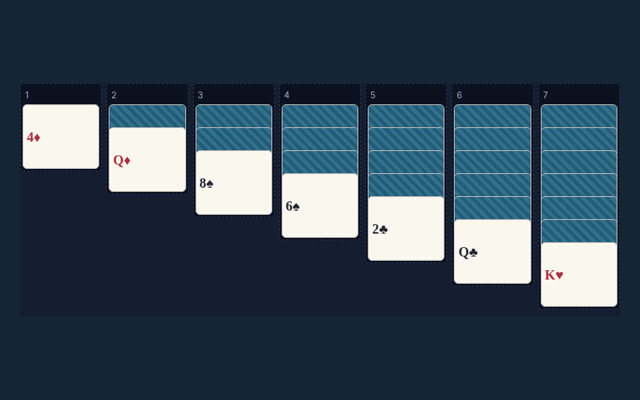
Click or tap cards and piles. Wide tableaus scroll inside the game; use Undo, Hint and New deal where shown. On a smaller screen, keep the active part of the board within view. A new-round button replaces the current round.
Work through an example
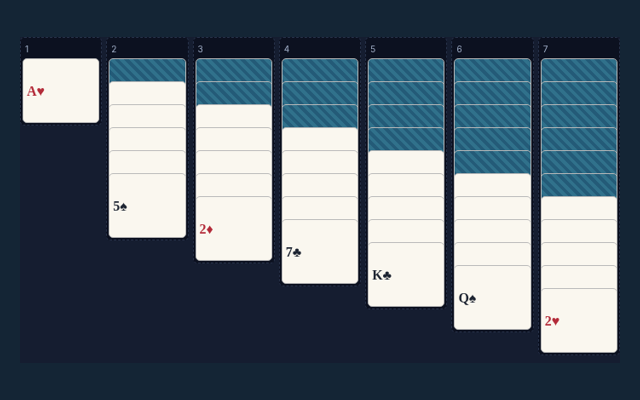
A mixed-suit descending stack cannot move as one group. Use the example as a guide rather than a substitute for reading your board. Read the matching step again.
Avoid this misunderstanding
Random deals are not guaranteed solvable. A hint is a legal move, not a winning strategy. Check the rule before repeating the action. Before your first action, say what you are trying to achieve. Then compare the result with the goal.
More answers before you play
For a quick reminder, what is the goal of Spider Solitaire?
Here is the relevant explanation: Complete eight same-suit king-to-ace runs.
As a new player, how do I control Spider Solitaire?
Here is the relevant explanation: Click or tap cards and piles. Wide tableaus scroll inside the game; use Undo, Hint and New deal where shown.
As a new player, what example helps explain Spider Solitaire?
The key detail is this: A mixed-suit descending stack cannot move as one group.
Before I begin, what should I watch out for in Spider Solitaire?
Here is the relevant explanation: Random deals are not guaranteed solvable. A hint is a legal move, not a winning strategy.
On this playing page, what format does Spider Solitaire offer?
For clarity: Two decks, one/two/four suits; fill every column before a ten-card stock deal. Free solo play, no wagering.
For this browser game, which play mode does Spider Solitaire use?
Here is the relevant explanation: The mode on this page is Solo. Same-device play uses one screen; this game library does not provide internet matchmaking.